Food Packaging Design for Startups: Concept to Print (US)
Step-by-step food packaging design guide for US startups: FDA compliance, dieline setup, print costs, and how to choose the right designer.
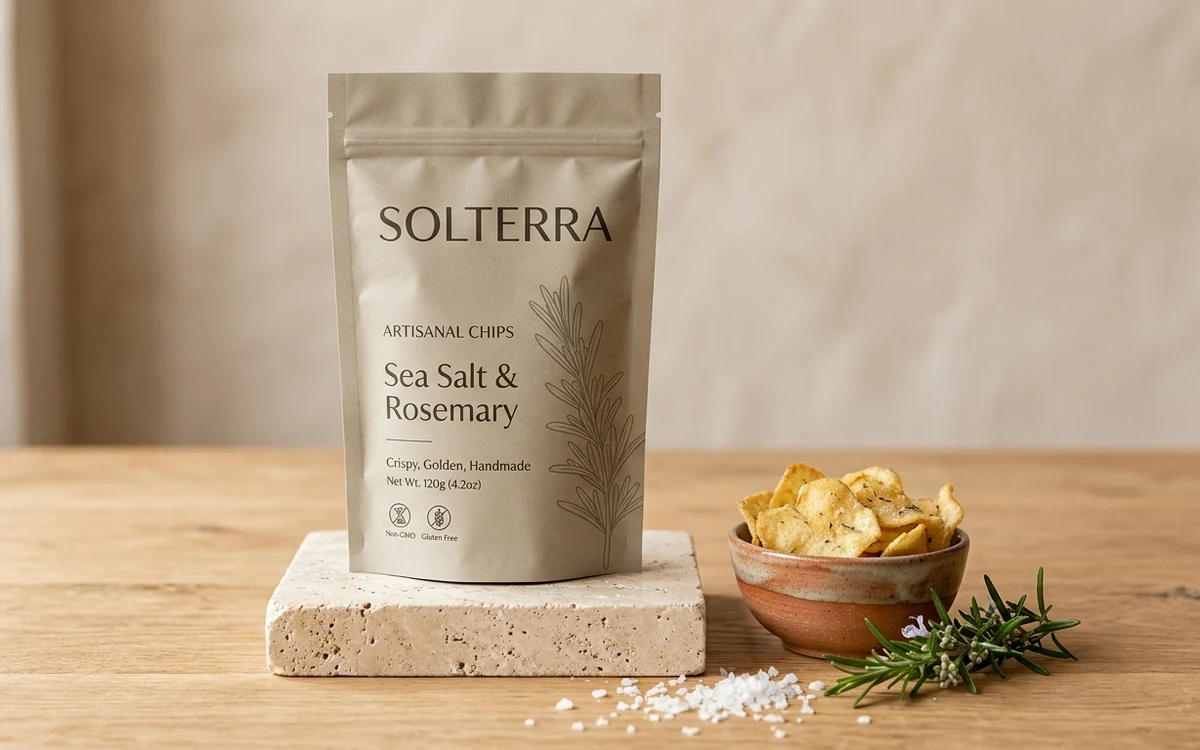
Designing food packaging for a US startup requires six sequential phases: brand positioning, structural format selection (pouch, carton, jar, or label), FDA regulatory panel layout (Nutrition Facts, allergens, UPC barcode), visual hierarchy and graphic design, dieline engineering with prepress setup, and prototyping through print production. Total cost ranges from $2,500 to $12,000 per SKU when working with a specialized CPG designer, and the end-to-end timeline averages 6 to 12 weeks from brief to print-ready files.
- FDA mandates 6 label elements on every packaged food: Statement of Identity, Net Quantity, Nutrition Facts, Ingredient List, Allergen Declaration (including sesame under the FASTER Act), and manufacturer details.
- Nutrition Facts panel requires minimum 6pt Helvetica for labels with 40+ sq in available area and 4.5pt for smaller packages (21 CFR 101.9).
- UPC-A barcodes need minimum 80% magnification with clear quiet zones of at least 2.5mm on each side for retail scanning.
- Digital printing allows Minimum Order Quantities as low as 250 to 500 units, making it ideal for market-testing before committing to flexographic or rotogravure runs.
- A third-party FDA compliance review costs $250 to $650 per SKU and can prevent costly retail rejections and reprints.
Every year, thousands of food startups launch in the United States with a great recipe and no idea how to turn it into a retail-ready package. The gap between a kitchen prototype and a shelf-facing, FDA-compliant, print-ready package is where most first-time CPG founders lose time, money, and confidence. This guide walks you through the entire food packaging design process from initial concept to final production files — covering the exact FDA labeling rules you need to build into your design, the structural format decisions that affect your unit economics, the prepress specifications your printer actually needs, and the real cost breakdown across every tier of design partner available in 2026.
Why Packaging Design Matters More for Startups Than Established Brands
An average US supermarket stocks over 40,000 SKUs. Your package has roughly 3 seconds to earn a shopper's attention before their eyes move on. Established brands like General Mills or Frito-Lay can rely on decades of brand recognition to sell — a startup cannot. For a first-time food product, the package IS the entire marketing strategy. It is simultaneously your billboard, your sales pitch, and your regulatory compliance document.
The stakes are high and the margin for error is thin. A 2025 Ipsos consumer survey found that 72% of American consumers say packaging design directly influences their purchase decision. For a startup with no advertising budget, no shelf talkers, and no brand ambassador, the package does all of that work alone.
Getting it wrong is expensive. Reprinting a full production run because you missed an FDA allergen declaration can cost $3,000 to $15,000. Getting rejected by a retail buyer at Whole Foods or Sprouts because your Nutrition Facts panel uses the wrong font size is a six-month setback. And designing a beautiful package that falls apart during shipping or fails to protect your product from moisture degradation means customer returns and negative reviews before you have earned any goodwill.
This is why custom food packaging design for startups requires a fundamentally different approach than designing for established brands. You are not refreshing an existing visual system — you are building one from zero, under tighter budget constraints, with no room for a second print run.
The 6-Phase Food Packaging Process: Concept to Print-Ready Art
The journey from product idea to a finished package sitting on a retail shelf follows six distinct phases. Skipping any of them — especially Phase 3 (FDA compliance) — creates expensive downstream problems.
Phase 1: Brand Strategy and Positioning
Before opening Adobe Illustrator, lock three foundational decisions: your brand positioning archetype (premium artisanal, mass-market value, or functional health), your exact brand name and logo, and your core messaging hierarchy (the 1 to 2 claims that will appear on the front panel). Changing any of these after packaging design has begun means restarting the entire process. If you have not yet built a visual identity system, read our guide on what is brand identity and why it matters before proceeding.
Conduct a physical shelf audit: visit the actual stores where your product will compete, photograph direct competitors, and map where the visual blind spots are. If every organic snack brand uses earth-tone kraft with green accents, your differentiation strategy should account for that saturation.
Phase 2: Structural Format Selection (Pouch, Carton, Jar, or Label)
Your packaging format determines your unit economics, shelf life, and visual real estate. Choose based on your product's physical protection needs, your target retail channel, and your launch budget.
| Format | Best For | Typical MOQ (Digital) | Per-Unit Cost Range | Shelf Life Benefit |
|---|---|---|---|---|
| Folding carton | Cereals, bars, tea, frozen meals | 1,000 to 2,500 units | $0.30 to $0.85 | Retail shelf presence, billboard space |
| Glass jar | Sauces, honey, preserves, nut butters | 200 to 500 units | $0.80 to $2.50 | Premium feel, reusable, transparent |
| Pressure-sensitive label | Bottles, jars, tubs, squeeze tubes | 250 to 500 units | $0.08 to $0.25 | Flexibility, easy variant swaps |
Pro tip for US startups: Start with digital printing on stock pouches or pressure-sensitive labels. This keeps your Minimum Order Quantity (MOQ) under 1,000 units, letting you test market fit before committing to expensive flexographic plates or rotogravure cylinders.
Phase 3: FDA Compliance and Regulatory Panel Layout
This is the section that separates professional food packaging design from amateur graphic design. Every packaged food product sold in the United States must comply with FDA labeling rules under 21 CFR Part 101. Missing any mandatory element can result in retail rejection, FDA warning letters, or product recalls.
The 6 mandatory FDA label elements:
1. Statement of Identity — The common name of the food (e.g., 'Roasted Chickpea Snack'), placed on the Principal Display Panel in bold type.
2. Net Quantity of Contents — Weight or volume in both metric and US customary units (e.g., '5 oz (142g)'), placed in the bottom 30% of the PDP with minimum type sizes based on package area.
3. Nutrition Facts Panel — Follows strict FDA formatting: minimum 6-point Helvetica for packages with 40+ sq in of label area, or 4.5-point for smaller packages. Must declare calories, total fat, sodium, total carbohydrate, protein, and other nutrients per serving and per container.
4. Ingredient List — Ingredients listed in descending order of predominance by weight. Sub-ingredients of compound ingredients must appear in parentheses.
5. Allergen Declaration — Must clearly identify all major food allergens under FALCPA: milk, eggs, fish, crustacean shellfish, tree nuts, peanuts, wheat, and soybeans. Since January 2023, the FASTER Act also requires sesame to be declared as a major allergen — a requirement many older design templates still miss.
6. Name and Place of Business — Full name and address (city, state, zip) of the manufacturer, packer, or distributor.
UPC barcode requirements for US retail: Your package needs a UPC-A barcode (12-digit) purchased from GS1 US. Design specs require minimum 80% magnification, quiet zones of at least 2.5mm on each side, and placement on a flat, non-curved surface. Print your barcode in black on white whenever possible — colored barcodes must pass a verification scan before production.
State-level callouts: If selling in California, check whether your product triggers a Proposition 65 warning for acrylamide, lead, or other listed chemicals. If selling compostable packaging in Washington State, ensure your claims comply with HB 1799 requiring third-party ASTM D6400 certification.
Always budget $250 to $650 per SKU for a third-party FDA compliance review before sending artwork to print. This single step prevents the most expensive mistake in food packaging: a compliant design that is not actually compliant.
Phase 4: Visual Hierarchy and Graphic Design
With your brand strategy locked and your regulatory text mapped, translate everything into a visual hierarchy. Consumers scan food packaging in a predictable order: Brand Logo → Product Name → Hero Callout (the 1 to 2 key claims) → Flavor or Variant → Details.
Organize your Primary Display Panel (front) into these zones: (1) Brand logo and mark at the top, (2) product name and variant clearly below it, (3) one or two hero callouts that communicate your core differentiator ('Plant-Based,' 'No Added Sugar,' 'USDA Organic'), and (4) appetite appeal through photography, illustration, or a transparent product window.
Your Information Panel (back or side) accommodates the Nutrition Facts table, ingredient list, allergen declaration, barcode, and manufacturer details. Design this panel first — it has the strictest space constraints — and then allocate remaining real estate to brand storytelling, usage instructions, or social media handles.
For guidance on selecting brand colors that drive appetite appeal and shelf differentiation, see our detailed guide on color psychology in branding.
Phase 5: Dieline Engineering and Prepress Setup
A packaging dieline is the 2D vector template that maps every cut line, crease score, bleed zone, and glue tab your packaging manufacturer needs to produce your package. Never design packaging artwork without the exact dieline from your printer or converter — generic downloaded templates often have incorrect seal widths, fold tolerances, or gusset dimensions.
Prepress checklist for print-ready food packaging files:
- Color mode: CMYK for process printing. For exact brand color matching, specify Pantone (PMS) spot colors.
- Resolution: All raster images and photography must be 300 DPI minimum at 100% print scale.
- Bleed: Extend background colors and artwork 3 to 5mm beyond the cut line to prevent white edges during die-cutting.
- Safe zone: Keep all critical text, logos, and barcodes at least 3 to 5mm inside the cut line to avoid clipping during folding and sealing.
- Outlined fonts: Convert all text to outlines (Cmd/Ctrl + Shift + O in Illustrator) so the printer does not encounter missing font errors.
- Export format: PDF/X-1a or high-quality print preset with embedded ICC profiles. Deliver source .AI files alongside final PDFs.
- Layer architecture: Organize your Illustrator file into separate layers: Die-cut layer (keyline only), Artwork layer, Foil/Spot UV layer (if applicable), and Regulatory text layer.
Phase 6: Prototyping, Proofing, and Print Production
Never trust a design solely on a computer monitor. Print your dieline at 100% scale on regular paper, cut it out, and fold it around a mock container. Step back 5 meters — can you read the brand name? Is the product instantly recognizable? This is the 5-meter shelf test, and it catches problems that screen previews cannot.
For flexible pouches or custom cartons, order a short-run physical prototype (most converters will produce 50 to 100 units digitally). Check structural integrity, zipper placement, seal strength, and how the package sits on a shelf or in a shipping box.
Printing method comparison for US food startups:
| Method | Best For | MOQ | Per-Unit Cost | Color Accuracy | Setup Cost |
|---|---|---|---|---|---|
| Flexographic | Scaling production, 3+ SKUs | 5,000 to 10,000 | Lower per-unit | Very good (spot + CMYK) | $800 to $2,500 per plate set |
| Rotogravure | High-volume national retail | 25,000+ | Lowest per-unit | Excellent (spot colors) | $3,000 to $8,000 per cylinder set |
Before approving mass production, your printer will send a digital PDF proof or a hard copy matchprint. Check spelling, barcode scannability (use a verification app), color accuracy against your Pantone swatch, and panel orientation (make sure the back panel is not upside down relative to the front). Sign off only after meticulous review.
How Much Does Food Packaging Design Cost in the US? (2026 Breakdown)
Packaging design costs vary dramatically based on the scope of work, the experience of the designer, and the complexity of your product. Here is how the US market segments in 2026:
| Design Partner Tier | Per-SKU Cost | What Is Included | Best For |
|---|---|---|---|
| Specialized CPG agency | $3,000 to $12,000 | Brand strategy + design + dieline engineering + 3D mockups | First-time founders, retail launch |
| Full-service agency | $10,000 to $30,000+ | Consumer research + brand identity + packaging + guidelines | Multi-SKU portfolio, national retail |
| Remote specialist (e.g., India) | $500 to $2,500 | Design + dieline + mockups + FDA panel layout | International brands seeking cost advantage |
What drives the variance? Four factors: (1) the number of SKUs — designing a coherent multi-flavor system costs more than a single product, (2) structural complexity — a custom die-cut carton requires more engineering than a stock pouch, (3) brand strategy scope — if you need positioning, naming, and logo design before packaging, that adds to the investment, and (4) revision cycles — most agencies include 2 to 3 rounds; additional revisions typically cost $75 to $150 per hour.
For US-based startups considering cost-effective options, read our analysis of why international brands outsource packaging design to India. Remote collaboration with a specialist who understands both FDA and international regulatory requirements can deliver professional results at 30 to 50% lower cost than a domestic agency. For a full breakdown of Indian market rates, see our packaging design cost guide.
Freelancer vs Boutique CPG Agency vs Full-Service: Which to Hire
Choosing the right design partner depends on three factors: your budget, your timeline, and how much strategic guidance you need beyond visual design.
Freelance designer ($1K to $3.5K): Best when you already have a locked brand identity, know exactly what format you want, and can provide the dieline yourself. Risk: most freelancers are web or graphic designers who have never prepared files for commercial food printing. Ask to see print-production portfolios, not just digital mockups.
Specialized CPG agency ($3K to $12K): The sweet spot for first-time founders. These firms design food packaging daily and understand FDA panel layout, dieline tolerances, and retail buyer expectations. They bridge the gap between creative branding and manufacturing constraints. Look for agencies that can show real printed packages, not just rendered 3D concepts.
Full-service agency ($10K to $30K+): Justified when you are launching a multi-SKU portfolio into national retail and need consumer research, brand architecture, packaging guidelines, and sell-sheet design as a unified system. Not necessary for a single-SKU launch or farmers' market test.
For a detailed comparison of working models across freelancers, agencies, and in-house designers, see our freelancer vs agency vs in-house comparison. If you are preparing your first packaging brief, our guide on how to write a design brief will save you and your designer hours of revision cycles.
Case Study: Concept-to-Print Walkthrough for a US-Bound Snack Brand
To make this process concrete, here is an anonymised walkthrough from a recent packaging project we completed for a US-bound organic snack startup.
The brief: A first-time founder based in California was launching a line of single-origin roasted nut products. The brand needed to feel premium and organic, compete visually against established players like Blue Diamond and Sahale Snacks on Whole Foods shelves, and comply with US FDA labeling requirements while also meeting India's FSSAI regulations for the brand's secondary market.
Phase 1 to 2 — Strategy and format: We positioned the brand in the premium-artisanal archetype: matte kraft textures, botanical illustrations, and generous negative space to contrast against the loud, foil-heavy competitor packaging dominating the nut aisle. The structural format was a high-barrier stand-up pouch with a resealable press-to-close zipper — selected for superior oxygen barrier properties (critical for preventing oxidative rancidity in high-oil nuts) and a 500-unit digital print MOQ that let the founder test market reception before scaling.
Phase 3 — Regulatory layout: We mapped both FDA and FSSAI regulatory panels simultaneously. The back panel was designed as a clean two-column grid accommodating US Nutrition Facts (21 CFR 101.9 formatting), FALCPA allergen declarations (tree nuts), FSSAI veg logo (3mm minimum circle), FSSAI license number, and dual GS1-128 and UPC-A barcodes with full quiet zone compliance. Total regulatory text occupied roughly 40% of the back panel — significantly more than the founder expected, which validated the decision to choose a larger pouch format early.
Phase 4 to 5 — Design and dieline: The primary display panel used a three-zone visual hierarchy: brand logo at top, hand-rendered botanical almond illustration at center (establishing appetite appeal and artisanal credentials), and a three-point benefit cluster at bottom (Zero Preservatives, High Vitamin E, Heart-Healthy Fats). The dieline was engineered for a multi-layer laminated pouch: 12-micron matte BOPP outer layer, 9-micron metallized PET oxygen barrier, and 70-micron food-grade sealable LLDPE inner layer. Prepress used 5-color separation (CMYK plus 1 spot Pantone 876 C copper metallic) with 3mm bleed and 0.2mm trapping tolerances.
Phase 6 — Production and results: After a physical prototype review and two rounds of design refinement, we delivered print-ready PDF/X-1a files with outlined fonts, separated spot color layers, and a press-ready color callout specification sheet. The founder launched with a 1,000-unit digital print run. Within three months, the product secured placement across 85+ premium retail locations and achieved a 42% increase in click-through rates on e-commerce platforms — the visual differentiation directly translated into commercial velocity.
This project illustrates two principles that apply to every US food startup: (1) map your regulatory panel space before designing your front panel — the compliance requirements dictate your format choice, and (2) start with digital printing to validate market fit before investing in flexographic plates.
5 Common Packaging Mistakes US Food Startups Make
After working with food brands across the US, India, UK, and UAE, these are the five mistakes I see most frequently from first-time CPG founders. For a deeper dive into packaging pitfalls, see our full guide on 10 packaging design mistakes that hurt sales.
1. Designing before locking brand identity. If your logo, brand name, or core positioning changes after packaging design has begun, you restart from zero. Lock your brand identity first.
2. Ignoring FDA panel space requirements. Founders consistently underestimate how much physical space the Nutrition Facts panel, ingredient list, and allergen declarations consume. On a small pouch, regulatory text can occupy 35 to 45% of total printable area. Design the back panel first.
3. Using RGB instead of CMYK. Colors designed in RGB (screen mode) shift dramatically when printed in CMYK (press mode). Your vibrant orange becomes a muddy brown. Always design in CMYK and specify Pantone spot colors for brand-critical elements.
4. Ordering large print runs before market validation. A 25,000-unit flexographic run saves money per unit but costs $8,000 to $15,000 upfront. If you need to change your recipe, claims, or design after launch, those units become waste. Start with 500 to 1,000 digital units.
5. Treating Amazon and retail packaging the same. Amazon requires FNSKU labels and frustration-free packaging certification for FBA. Retail stores need shelf-facing orientation, UPC barcodes, and sometimes shelf-ready packaging (SRP) trays. Design for your primary channel first, then adapt.
Frequently Asked Questions: Food Packaging Design for US Startups
How long does food packaging design take from concept to print?
For a single SKU with an established brand identity, expect 6 to 8 weeks from initial brief to print-ready files. If you need brand strategy, logo design, and packaging designed together, plan for 10 to 14 weeks. Rush timelines of 3 to 4 weeks are possible but typically carry premium fees.
Do I need FDA approval for my food packaging design?
No. The FDA does not pre-approve food labels or packaging designs. However, your packaging must comply with all FDA labeling regulations under 21 CFR Part 101. If your label is non-compliant, the FDA can issue warning letters, and retailers will reject your product. A third-party compliance review ($250 to $650 per SKU) is strongly recommended before printing.
What file format does my printer need for food packaging?
Most commercial food packaging printers require vector PDF files (PDF/X-1a preset) with all fonts outlined and images at 300 DPI minimum. Deliver Adobe Illustrator (.AI) source files alongside final PDFs. Include a separate color callout sheet specifying exact Pantone (PMS) numbers for spot colors.
Can I design my own food packaging on Canva?
For a farmers' market test run, possibly. For retail distribution, no. Canva exports RGB raster files that are not suitable for commercial printing. It cannot handle dieline setup, Pantone spot colors, bleed/safe zone specifications, or FDA-compliant Nutrition Facts formatting. Professional packaging design requires Adobe Illustrator or equivalent vector software.
What is the minimum order quantity for custom food packaging?
With digital printing, MOQs can be as low as 250 to 500 units for pouches and labels, or 500 to 1,000 for folding cartons. Flexographic printing typically starts at 5,000 to 10,000 units due to plate setup costs. Rotogravure requires 25,000+ units.
How do I get a barcode for my food product in the US?
Purchase a GS1 Company Prefix from GS1 US. A single UPC barcode starts at $30 per year. A Company Prefix (allowing you to generate barcodes for multiple products) starts at $250 per year for small businesses with under $1M in annual revenue. Never buy barcodes from third-party resellers — major retailers like Walmart and Whole Foods require GS1-issued codes.
Freelance packaging & brand identity designer based in New Delhi, India. Helping D2C startups, food & beverage brands, and international companies build FSSAI-compliant packaging dielines, luxury rigid boxes, and shelf-ready visual identities.
Get a Fixed-Price Quote in 24 Hours
Send your packaging format, SKU count, and launch date. Receive a transparent itemized proposal with vector dielines and printer coordination.