Coffee Packaging Design: How Independent Roasters Win Shelves
A specialty coffee roaster guide to packaging design: flat-bottom box pouches, one-way degassing valves, origin storytelling labels, barrier laminates, and dielines.
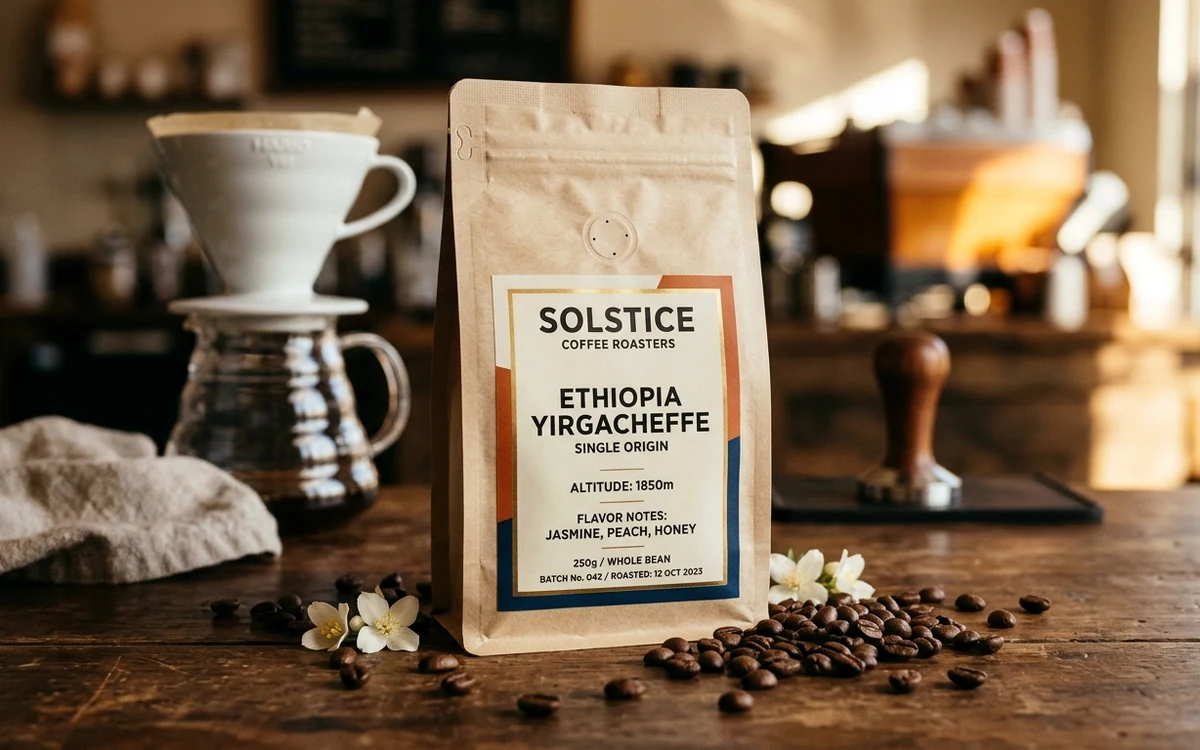
Coffee packaging design for specialty roasters focuses on three pillars: barrier protection (EVOH, aluminum foil, or high-barrier metallized films with one-way degassing valves), functional convenience (pocket zippers and stable flat-bottom box pouches), and clear label hierarchy (origin, elevation, process, roast degree, and tasting notes). Roasters typically choose between fully custom-printed pouches (5,000+ MOQ) or modular custom labels on pre-formed stock pouches (low MOQ).
- Freshly roasted coffee off-gasses carbon dioxide (CO2) for 7 to 14 days, requiring a one-way degassing valve to prevent bag ballooning while blocking oxygen ingress.
- Flat-bottom box pouches offer 5 printable panels and superior shelf stability compared to traditional quad-seal or pillow pouches.
- Oxygen transfer rate (OTR) must remain below 0.5 cc/m²/24hr to prevent staling of aromatic volatile coffee oils (caffeol).
- Specialty coffee buyers inspect five key data points: Country & Region, Processing Method (Washed/Natural/Honey), Variety, Altitude (MASL), and Tasting Notes.
- Small-batch roasters save thousands by printing modular adhesive labels applied to neutral matte white, black, or natural kraft stock bags.
In third-wave specialty coffee, packaging is the bridge between months of painstaking green bean sourcing, cupping profile development, and the sensory ritual of the customer's morning brew. Whether displayed on local café counters, specialty grocery shelves, or arriving via monthly D2C subscription boxes, a coffee bag must communicate exceptional craftsmanship before the customer ever smells the beans. However, engineering an elite coffee bag is a demanding technical science. Freshly roasted coffee is a living, volatile product that continuously releases carbon dioxide while being acutely vulnerable to oxidation, moisture, and ultraviolet degradation. This guide explores the core structural pouch formats, degassing valve mechanics, label architecture, and printing methodologies that empower independent coffee roasters to captivate shoppers and command premium $18 to $26 bag prices.
1. Specialty Coffee Shelf Battle: Winning Grocery & Cafes
Walk into any specialty coffee shop or premium grocer today, and you will be greeted by a vibrant gallery of 250g and 12oz coffee bags. Because customers cannot open the bag to taste the coffee inside before purchasing, packaging bears 100% of the responsibility for driving first-time trial.
Specialty coffee consumers fall into two distinct psychological personas: the Sensory Connoisseur (who meticulously analyzes varietal genetics, processing methods, elevation, and cupping scores) and the Lifestyle Storyseeker (who connects with aesthetic illustration, ethical sourcing narratives, and roast profile simplicity). Outstanding coffee packaging design bridges both personas by delivering an immediate, emotional aesthetic hook on the front face while organizing deep origin data on structured secondary panels.
Furthermore, the physical hand-feel of the coffee bag reinforces perceived quality. A rigid, balanced flat-bottom box pouch made with textured uncoated kraft or smooth velvet soft-touch film immediately signals artisanal pedigree compared to flimsy, floppy supermarket pillow packs.
2. Bag Formats: Stand-Up Pouches vs Flat-Bottom Box Bags
Selecting the physical pouch format determines your bag's retail presence, packing line efficiency, and printable surface area:
• Flat-Bottom Box Pouches (The Premium Gold Standard): Featuring a completely flat, rectangular base and four crisp vertical sealed corners, the flat-bottom pouch stands perfectly erect on retail shelves without slumping or tipping over. It provides five distinct printable panels (front, back, left gusset, right gusset, bottom), allowing roasters to display expressive artwork on the front while dedicating side gussets to brew guides and farm stories.
• Traditional Stand-Up Pouches (Doypack): The most cost-effective flexible packaging format. Incorporates a rounded bottom gusset that expands when filled. While economical, standard Doypacks can tilt forward on store shelves when bean levels settle unevenly.
• Quad-Seal and Side-Gusset Bags: The heritage format for commercial coffee. Features side gussets with corner heat seals. While sturdy, side-gusset bags lack resealable pocket zippers, requiring roasters to supply tin-ties or asking consumers to use kitchen bag clips.
For modern retail convenience, always specify a pull-tab pocket zipper positioned below the top heat-seal line. This allows consumers to rip open the tamper-evident header effortlessly and re-close the airtight zipper after every brew.
3. Preserving Freshness: One-Way Valves & Barrier Films
During the roasting process, thermal pyrolysis creates enormous volumes of carbon dioxide (CO2) trapped inside the bean's cellular matrix. Over the first 7 to 14 days post-roast, freshly roasted beans emit several liters of CO2 per kilogram. Without proper venting, an airtight sealed bag will inflate like a balloon and rupture during transport.
The solution is the one-way degassing valve. This precision-engineered mechanical valve consists of a microscopic rubber disc and silicone oil seal that permits internal CO2 pressure to vent outward while preventing ambient oxygen (O2) and moisture from entering. Oxygen is the mortal enemy of coffee freshness: exposure to oxygen oxidizes delicate caffeol aromatics within 72 hours, resulting in flat, cardboard-tasting coffee.
To achieve a 12-month commercial shelf life, your pouch laminate structure must feature an Oxygen Transmission Rate (OTR) of less than 0.5 cc/m²/24hr. Traditional bags achieve this through a 3-layer laminate: Matte BOPP or Kraft Paper (outer printable layer) + Aluminum Foil or Metalized PET (middle barrier layer) + Linear Low-Density Polyethylene (LLDPE, inner food-contact heat seal layer).
4. Specialty Label Architecture: Origins, Altitude & Notes
Specialty coffee buyers expect deep transparency and disciplined data hierarchy on the packaging. Your label layout should follow an intuitive visual sequence:
1. Primary Brand Identity & Coffee Name: The roaster's logo mark and the signature coffee blend or single-origin name (e.g., "Yirgacheffe Gedeb", "Midnight Horizon Espresso").
2. The Sensory Hook (Tasting Notes): Display 3 to 4 vivid, calibrated flavor descriptors (e.g., "Bergamot, Jasmine, White Peach & Meyer Lemon") in high-contrast typography. Tasting notes provide the fastest emotional trigger for customer selection.
3. Single-Origin Technical Provenance: Detail the origin data in clean typographic grids: Country & Region (e.g., "Huila, Colombia"), Producer / Farm ("Finca El Paraiso"), Altitude ("1,850 - 2,050 MASL"), Botanical Variety ("Pink Bourbon, Geisha"), and Processing Method ("Anaerobic Thermal Shock").
4. Roast Profile Indicator: A clean visual continuum bar (Light, Medium-Light, Medium, Dark) preventing customer confusion between espresso extractions and delicate pour-over roasts.
5. Roast Date & Transparency: A dedicated stamp or white window for the "Roasted On" date, proving fresh artisanal roasting.
5. Custom Direct-Printed Pouches vs Modular Stock Labels
For emerging coffee roasters, balancing packaging investment against cash flow is vital (consult our packaging design cost breakdown and guide on how to choose a packaging designer). Roasters typically navigate two distinct packaging phases:
• Phase 1: Modular Label Architecture on Neutral Stock Pouches: Small roasters carrying 8 to 15 revolving single-origin micro-lots cannot afford custom printed bags for every farmer lot (which require 5,000+ unit MOQs per design). Instead, order pre-formed neutral matte black, matte white, or raw kraft bags in bulk with pre-installed degassing valves and pocket zippers. Then, design an expressive, custom-die-cut front label and back label printed on digital roll presses. This allows you to launch new seasonal harvests with zero plate fees and MOQs as low as 100 labels.
• Phase 2: Fully Custom-Printed Digital or Rotogravure Bags: Once flagship espresso blends or signature coffees sell 1,000+ bags monthly, transition to direct digital or rotogravure printed pouches. This unlocks edge-to-edge printing across all five panels, internal gusset branding, and custom color-matched degassing valves.
6. Sustainable Substrates: Recyclable PE & Uncoated Kraft
Coffee drinkers display an exceptionally high environmental consciousness. As municipal recycling infrastructure evolves, roasters are moving away from traditional non-recyclable aluminum foil laminates toward circular packaging models:
• Certified Industrial Compostable Bags (Bio-Pouches): Manufactured using plant-based cellulose derived from wood pulp (outer layer) and biodegradable polybutylene succinate (PBS) or polylactic acid (PLA) inner sealants, paired with certified compostable degassing valves. These break down cleanly in commercial composting facilities within 90 to 180 days.
• Recyclable Mono-Material Polyethylene (Mono-PE): Traditional multi-material laminates (PET + Foil + PE) cannot be recycled because the bonded layers cannot be separated. Mono-material pouches engineer all layers from pure high-density and low-density polyethylene, maintaining excellent oxygen barriers while qualifying for How2Recycle Store Drop-off programs.
• Uncoated Raw Kraft Paper: Delivers authentic, organic tactile warmth that resonates deeply with artisanal craft coffee drinkers.
7. Prepress Engineering: Pouch Dielines & Valve Clearances
Designing for flexible pouches requires accounting for heat-sealing machine tolerances and structural fold lines:
• Valve Placement Clearance: The one-way degassing valve is ultrasonically heat-welded from the inside, typically centered 30mm to 45mm below the top zipper seal. Keep all critical typography, micro-text, and logo marks at least 15mm clear of the circular valve weld zone to avoid distorted graphics.
• Side Gusset and Bottom Crease Offsets: Graphic elements that cross over side gusset score lines will shift slightly during pouch filling and machine forming (+/- 1.5mm tolerance). Never position tight text or geometric patterns directly across corner folds.
• Barcode Prepress Specifications: Place the GS1 UPC-A barcode on the back panel or bottom panel with a minimum 80% magnification and pure white quiet zones, ensuring cashiers and café baristas can scan bags instantly without reflection glare.
Working with an experienced packaging designer who understands coffee chemistry, valve placements, and flexible dieline engineering ensures your roastery ships packaging that preserves peak aromatics and captivates coffee lovers.

Freelance packaging & brand identity designer based in New Delhi, India. Helping D2C startups, food & beverage brands, and international companies build FSSAI-compliant packaging dielines, luxury rigid boxes, and shelf-ready visual identities.
Get a Fixed-Price Quote in 24 Hours
Send your packaging format, SKU count, and launch date. Receive a transparent itemized proposal with vector dielines and printer coordination.