Supplement Packaging Design: Premium Labels for US Wellness
A regulatory and visual guide to designing custom supplement packaging for US wellness startups — FDA Supplement Facts panels, cGMP trust badges, bottle dielines, and print specs.
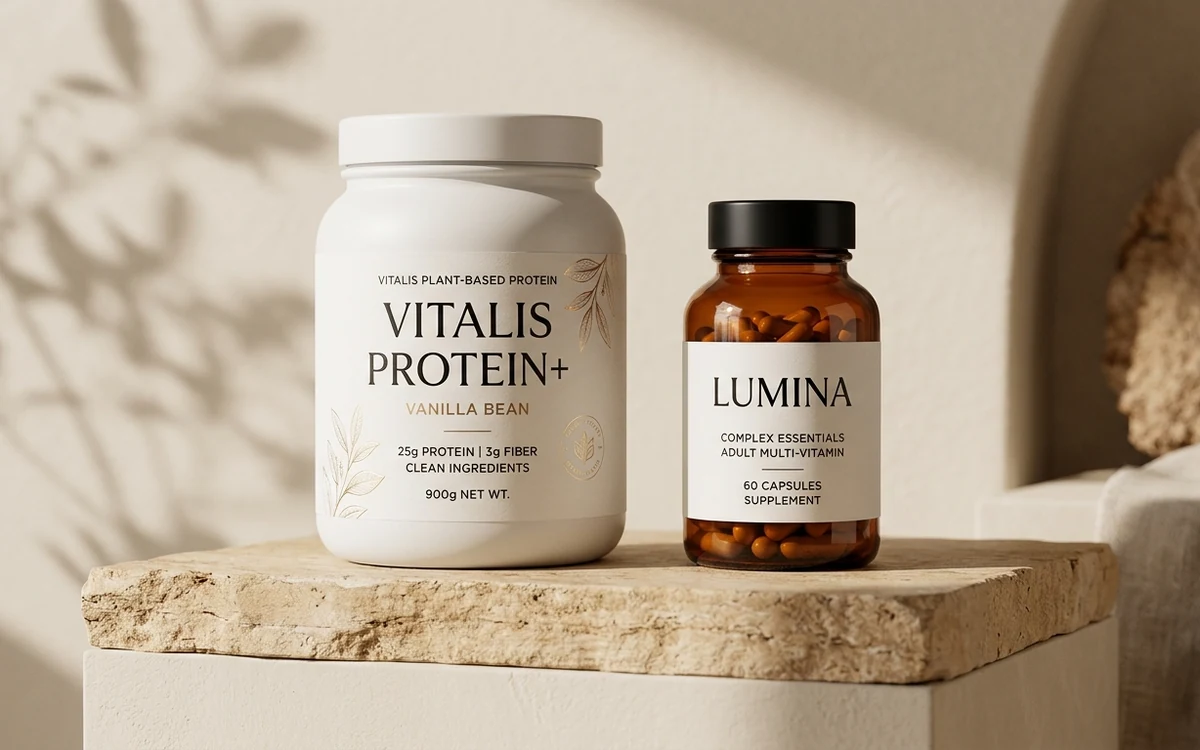
Designing dietary supplement packaging for the US market demands strict compliance with FDA 21 CFR 101.36 (Supplement Facts panel typography, % Daily Value formatting, allergen warnings, and structure/function claim disclaimers) paired with clinical, trustworthy visual hierarchy. Packaging typically utilizes HDPE/PET bottles with induction seals and tamper-evident shrink neck bands, costing $1,500 to $4,500 per SKU for design.
- FDA mandates a standardized Supplement Facts panel with exact hairline dividers, bold nutrient titles, and FDA disclaimer box for unapproved structure/function claims.
- Dietary ingredients with an established Daily Value must appear above a heavy 3-point bar; proprietary blends appear below with total weight.
- Most capsule and tablet supplements use 100cc to 300cc amber or white PET/HDPE packers with 38-400 or 45-400 neck finishes.
- Tamper-evident heat-shrink neck bands and pressure-sensitive induction cap liners are non-negotiable for retail and Amazon compliance.
- Metallic BOPP substrate with selective white underprinting creates metallic foil sheen on logos without the high cost of hot stamping.
In the fast-expanding US dietary supplement and nutraceutical industry, packaging carries a heavier burden than in almost any other consumer product category. Unlike general food or beverage items, supplements are ingested with the explicit expectation of enhancing physical vitality, cognitive focus, longevity, or gut health. Consequently, consumer skepticism is naturally elevated. An amateurish label, cramped typography, or missing regulatory disclaimer instantly signals an unsafe, fly-by-night operation. Conversely, a masterfully engineered supplement package projects uncompromising clinical rigor, lab-verified potency, and modern lifestyle elegance. This detailed guide breaks down the essential legal mandates of FDA 21 CFR 101.36, container selection protocols, trust-building certification badges, and prepress label engineering required to build a compliant, best-selling US supplement brand.
1. US Wellness Market: Building Instant Clinical Authority
The US dietary supplement market now surpasses $60 billion, fueled by mainstream adoption of functional mushrooms, nootropics, adaptogens, liposomal vitamins, and gut microbiome probiotics. However, modern wellness consumers have evolved dramatically beyond the traditional bodybuilder and multi-vitamin paradigms. Today's shoppers research active bioavailability, clinical dosages, and clean excipients on Reddit and TikTok before making a purchase.
On retail shelves at Whole Foods, Sprouts, GNC, and Target—or within the crowded search feeds of Amazon and D2C stores—your label has approximately three seconds to answer three subconscious questions: "Is this formulation safe?", "Is it dosed effectively?", and "Does this align with my personal identity?"
To convert discerning buyers, modern supplement packaging rejects cluttered 1990s bodybuilding tropes in favor of clean, pharmaceutical-grade visual systems. Generous negative space, disciplined typographic scales, and high-contrast information hierarchies communicate that your brand respects scientific accuracy over empty marketing hyperbole.
2. FDA 21 CFR 101.36 Supplement Facts Panel Layout Rules
In the United States, dietary supplements are regulated under the Dietary Supplement Health and Education Act (DSHEA) and 21 CFR 101.36. (Compare this with conventional food labeling in our food packaging design guide and FSSAI label rules). The centerpiece of every supplement package is the mandatory Supplement Facts panel, which possesses strict structural, typographic, and organizational requirements that cannot be altered for aesthetic whim:
• The Box Architecture: The panel must be enclosed in an unbroken black hairline border. The title "Supplement Facts" must be set in bold, uppercase or title-case type that is larger than any other type in the panel (typically 10pt to 13pt bold Helvetica or Arial).
• Serving Size and Servings Per Container: Must appear directly below the main title, separated by a distinct hairline divider. The serving size must reflect the quantity of the product (e.g., "2 Capsules", "1 Scoop (12.5g)") recommended for consumption on the directions panel.
• Two-Tier Nutrient Architecture: Dietary ingredients with an established Daily Value (DV) (such as Vitamin C, Zinc, Magnesium) must be listed first, accompanied by quantitative amounts and % Daily Values based on FDA Reference Daily Intakes. A heavy 3-point black bar must separate these standard nutrients from proprietary dietary ingredients (such as herbal extracts, ashwagandha, or lion's mane) that have no established Daily Value.
• The Mandatory Structure/Function Claim Disclaimer: If your packaging makes statements regarding the product's effect on the structure or function of the human body (e.g., "Supports Immune Function*", "Promotes Restful Sleep*"), the FDA strictly mandates an asterisk linking directly to the exact statutory disclaimer box: "These statements have not been evaluated by the Food and Drug Administration. This product is not intended to diagnose, treat, cure, or prevent any disease."
3. Container Selection: Amber Glass, HDPE Packers & Pouches
Choosing the correct structural vessel protects delicate active ingredients against moisture absorption, photo-oxidation, and chemical degradation throughout a 24-month shelf life:
• Pharmaceutical Packers (100cc to 400cc): The standard container for capsules, tablets, and softgels. White High-Density Polyethylene (HDPE) provides outstanding moisture barrier properties and durability against drop impacts. For premium apothecary-positioned brands, amber molded glass provides 100% UV protection for light-sensitive botanical extracts while imparting substantial tactile shelf presence.
• Wide-Mouth Protein & Collagen Tubs (32oz to 5lb): Utilized for meal replacement powders, BCAAs, and electrolyte blends. Wide 89-400 or 110-400 neck finishes ensure easy scooper access. Designers must specify full-body heat shrink sleeves with micro-perforations to wrap complex container shoulder curves.
• Amber Tincture Bottles (1oz / 30ml and 2oz / 60ml): The premier delivery format for liquid herbal drops, sublingual tinctures, and liposomal oils. Glass dropper pipettes should feature graduated volume markings (0.25ml, 0.5ml, 0.75ml, 1.0ml) printed in chemical-resistant ink.
• Multi-Layer Stand-Up Pouches: Gaining massive traction for vegan protein powders and green superfoods due to lower carbon shipping footprints and modern D2C aesthetic appeal. Always specify metallized foil barriers with resealable press-to-close zippers.
4. Essential Trust Badges: cGMP, Third-Party Testing & NSF
Trust badges are critical visual shortcuts that validate product purity and manufacturing legitimacy on crowded retail shelves. However, placing them on your supplement label requires strict legal substantiation:
• cGMP Certified (Current Good Manufacturing Practices): Indicates that your contract manufacturer operates under FDA 21 CFR 111 cGMP regulations, ensuring rigorous testing for ingredient identity, purity, strength, and composition. The badge should appear on the side or back information panel.
• Third-Party Lab Tested: Confirms that every production batch is verified by an independent ISO/IEC 17025 accredited laboratory for heavy metal limits (lead, arsenic, cadmium, mercury), microbiological pathogens, and label potency.
• Certified Vegan / Non-GMO Project Verified / Gluten-Free: Specialized dietary certifications require official licensing agreements before displaying registered certification marks. Always reserve vector space on side panels for verified certification iconography.
• Allergen Warning Statement: Under the Food Allergen Labeling and Consumer Protection Act (FALCPA) and the FASTER Act, if your supplement contains any of the major 9 allergens (Milk, Eggs, Fish, Crustacean Shellfish, Tree Nuts, Peanuts, Wheat, Soybeans, Sesame), a bold "Contains: [Allergen]" callout must be positioned immediately beneath the ingredient declaration.
5. Tamper-Evidence: Induction Seals & Shrink Neck Bands
In the supplement sector, product safety and tamper-evidence are non-negotiable legal and commercial prerequisites. Retail distributors and fulfillment centers like Amazon FBA immediately reject unsealed ingestible inventory.
Your production packaging specifications must integrate multi-barrier tamper protection:
1. Pressure-Sensitive and Induction Foil Cap Liners: Heat-induction inner foil seals fuse permanently to the container lip during capping, creating a hermetic airtight seal that blocks moisture humidity and proves the bottle has never been breached.
2. Tamper-Evident Heat Shrink Neck Bands: A transparent or branded PVC/PETG shrink sleeve wrapped tightly around the bottle cap and neck, featuring vertical perforations for clean consumer removal.
3. Child-Resistant (CR) Closures: Legally mandated under the Poison Prevention Packaging Act (PPPA) for dietary supplements containing iron (over 250mg elemental iron per package), utilizing push-and-turn safety caps to protect young children.
6. Substrates & Finishes: Matte BOPP Labels & Cold Foil
The substrate material you select for your bottle labels fundamentally governs how your brand is perceived in a customer's hands:
• Biaxially Oriented Polypropylene (BOPP) Film: Paper labels absorb moisture, oil, and humidity, quickly turning soggy or peeling in bathroom cabinets. BOPP is an ultra-durable plastic film that resists oils, water, and scuffing, making it the mandatory standard for supplement bottles.
• Metallic BOPP with Selective White Underprinting: To achieve stunning metallic gold, bronze, or platinum foil effects on brand logos and border trims without paying expensive hot stamping die tooling fees, print on metallic silver BOPP film. By printing an opaque white ink barrier layer beneath all text and graphics, while leaving your logo areas transparent, the underlying metallic silver shines through the colored ink with brilliant chrome luster.
• Soft-Touch Matte Lamination: Eliminates glossy plastic glare on Amazon and retail shelves, providing an elegant tactile grip that feels warm and premium to the touch.
• High-Gloss Spot UV Embellishments: Juxtapose high-gloss clear varnish over key active ingredient names, clinical potencies, or botanical illustrations against a dead-matte background to guide the eye across the label's primary visual hierarchy.
7. Prepress Production: Label Bleed & Barcode Quiet Zones
Prepress setup for cylindrical bottles presents unique mechanical challenges compared to flat folding boxes (review our master guide on what is a packaging dieline and our transparent packaging design cost breakdown):
• Cylindrical Label Bleed and Unprinted Margins: Always extend background art and colors 0.125 inches (3mm) beyond the label die line. For wrap-around labels on circular packers, leave an unprinted 0.0625-inch gap at the trailing adhesive edge to prevent ink-on-adhesive seam slippage during high-speed rotary labeling lines.
• Barcode Magnification and Quiet Zones: UPC-A barcodes must be calibrated to at least 80% magnification (1.18 inches wide by 0.816 inches tall) with clear quiet zones of at least 0.125 inches on both sides. On small diameter bottles (e.g. 1oz droppers), orient the barcode vertically (in "ladder" orientation) rather than horizontally ("picket fence") to prevent optical scanner laser beam distortion around the cylinder's curvature.
• Color Consistency Across SKUs: Use standardized Pantone spot colors for core brand logos to maintain identical color consistency across different bottle materials, protein tubs, and outer shipping master cases.
Partnering with an experienced packaging designer who understands both FDA compliance and industrial flexographic printing ensures your supplement range looks clinical, trustworthy, and commanding on the shelf from Day 1.

Freelance packaging & brand identity designer based in New Delhi, India. Helping D2C startups, food & beverage brands, and international companies build FSSAI-compliant packaging dielines, luxury rigid boxes, and shelf-ready visual identities.
Get a Fixed-Price Quote in 24 Hours
Send your packaging format, SKU count, and launch date. Receive a transparent itemized proposal with vector dielines and printer coordination.