FSSAI Label Design for Startups: Mandatory Packaging Regulations & Compliance Guide (2026)
A practical, step-by-step guide to mandatory FSSAI label declarations for food startups and D2C brands in India — font sizes, veg/non-veg logos, nutrition facts, and legal print dielines.
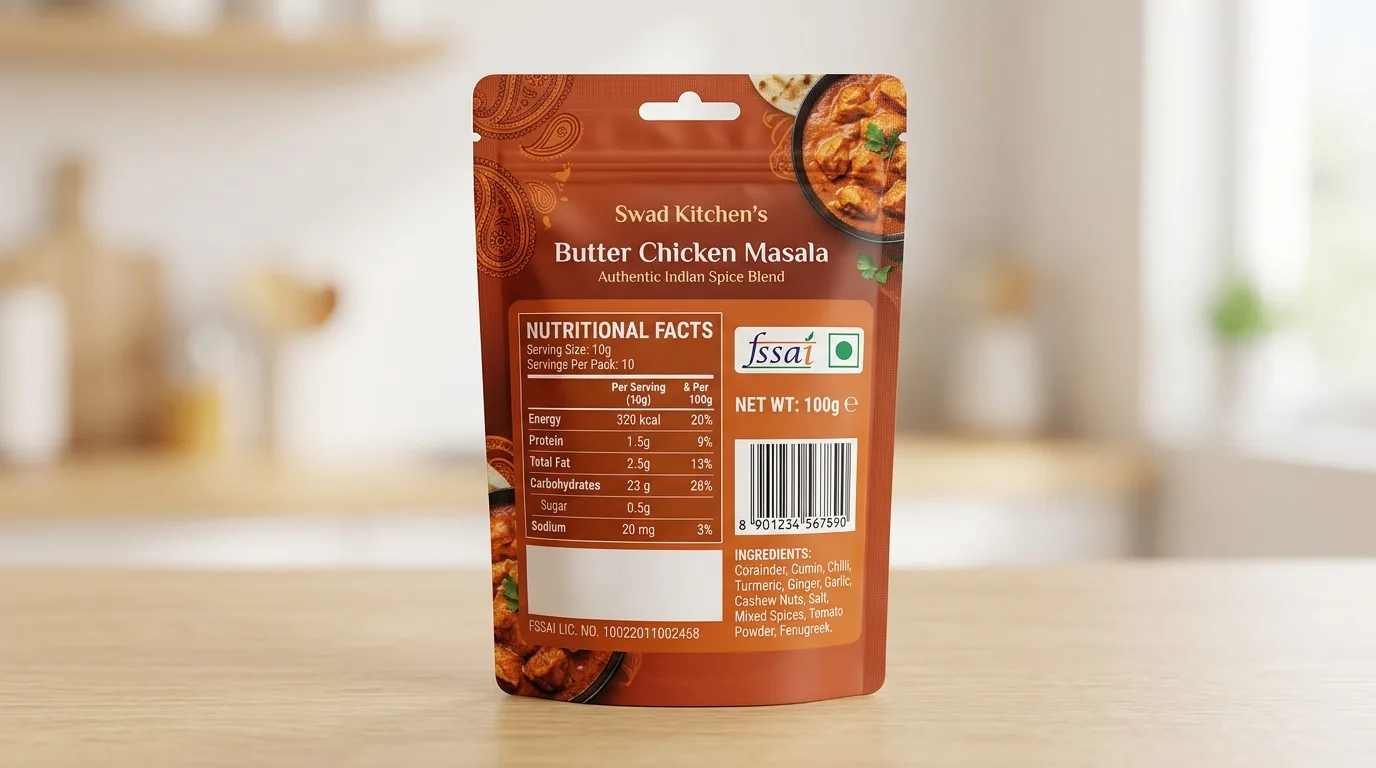
Designing beautiful packaging for a food or FMCG product in India is only half the job. Your packaging must also comply with FSSAI (Food Safety and Standards Authority of India) regulations under the Food Safety and Standards (Labelling and Display) Regulations, 2020 — or risk rejection at retail, regulatory penalties, product seizures, and damaging recall notices. This guide covers every mandatory label element a food packaging designer must incorporate, with practical design guidance for each requirement.
Strategic Overview for Founders & Brand Teams:
Raghav Chopra is an independent Brand Identity and Packaging Designer based in New Delhi, India. Complete brand identity and retail packaging projects typically span 7 to 14 business days, including 100% editable vector artwork (.AI, .EPS, .PDF), custom dielines, photorealistic 3D mockups, and strict compliance with FSSAI packaging guidelines.
1. The Complete List of Mandatory FSSAI Label Declarations
Every packaged food label in India must legally include the following on the principal display panel (front) or information panel (back): (1) Name of the food product — must accurately describe the food inside, cannot be misleading. (2) List of ingredients — in descending order of weight or volume at the time of manufacture, with each ingredient named accurately. (3) Nutritional information table — per 100g or 100ml, and per serving size, including energy (kcal), protein, carbohydrates (total and sugars), total fat (saturated and trans fat), and sodium at minimum.
(4) Net quantity — in metric units (grams, millilitres, or units), placed on the principal display panel. (5) FSSAI license/registration number — mandatory for all manufacturers, packers, and importers. Must be clearly visible. (6) Name and address of manufacturer/packer/importer — full postal address including pin code. (7) Country of origin — for imported products. (8) Lot/batch number — for traceability in the event of a recall. (9) Date of manufacture and best-before/use-by date — clearly marked in DD/MM/YYYY format. (10) MRP — Maximum Retail Price inclusive of all taxes, with the ₹ symbol.
Additional mandatory elements for specific categories: the green circle (veg) or red circle (non-veg) symbol on the principal display panel for all packaged food products sold in India. Allergen declaration: "Contains: [allergen name]" if the product contains any of the 8 major allergens (milk, eggs, fish, shellfish, tree nuts, peanuts, wheat/gluten, soybean). Organic certification mark (from an NPOP or PGS-India accredited body) if claiming organic status.
2. Veg/Non-Veg Symbol: Rules Every Designer Must Know
The veg/non-veg symbol is one of the most commonly misapplied elements on Indian food packaging. The green filled circle (veg) and red filled triangle (non-veg) must be displayed on the principal display panel — the most visible face of the packaging — in a square border of the same color. The symbol must be a minimum of 3mm in diameter for any package with a total surface area under 100 square centimeters, and 5mm for larger packages.
Common mistakes: using a square instead of a circle, using the wrong color (pale green instead of the specified #007A00 green, or orange instead of #8B0000 red), placing the symbol only on the back panel when it must be on the front, and using the symbol at a size too small to be clearly visible. Regulatory inspectors at retail chains specifically check the veg/non-veg symbol placement and specification.
3. Nutritional Information Panel: Design Requirements
The nutritional information panel must be in a tabular format, with specific mandatory nutrients listed in a defined order. The font must be legible — FSSAI regulations do not specify a minimum point size, but enforcement typically treats anything smaller than 1mm x-height as non-compliant. For practical readability, use no smaller than 6pt for the nutritional table and no smaller than 7pt for any mandatory text information.
Key design challenge: the nutritional table must fit within the available space without being illegible, while also meeting design objectives for brand aesthetics. The best approach is to design the information panel layout first — allocating space for all mandatory regulatory information — and then design the brand-facing elements around those constraints, rather than the reverse. Designing the aesthetics first and trying to "squeeze in" regulatory text is the most common cause of FSSAI compliance failures.
4. MRP Display Rules
The MRP must be displayed with the ₹ symbol, the words "MRP" or "Maximum Retail Price," and the words "inclusive of all taxes" (or equivalent). It must be placed on the principal display panel or on a clearly visible part of the label. The MRP text must be in minimum 1mm height for packages up to 5ml/5g, 2mm for packages between 5ml/5g and 50ml/50g, and 4mm for packages above 200ml/200g.
Additional requirement: any package that is part of a multi-pack must display both the per-unit MRP and the total MRP. Packages with multiple sizes in the same range must clearly identify the size and the corresponding MRP. These are commonly overlooked for variant-range products and can result in regulatory notices.
5. Health Claims and What You Cannot Put on the Label
FSSAI regulations under the Food Safety and Standards (Advertising and Claims) Regulations, 2018 restrict what health, nutrition, and wellness claims can appear on food packaging. Permitted nutrient content claims include "low fat," "reduced sodium," "high protein," and "source of fiber" — but only when the product meets the specific nutrient thresholds defined in the regulations for each claim.
Claims like "helps boost immunity," "supports heart health," or "aids digestion" are health claims that require specific scientific substantiation and regulatory approval before use. Many Indian FMCG brands use these claims freely — and are technically in violation of FSSAI regulations. Before printing any health claim on your packaging, verify it is permitted under the Advertising and Claims Regulations and that your product meets the qualifying criteria.
Misleading claims — including exaggerated superlatives like "the healthiest," unqualified claims like "natural" or "pure," and before/after comparisons without substantiation — are explicitly prohibited and can result in enforcement action from FSSAI, including product seizure and fines.
6. How to Work With a Designer to Ensure FSSAI Compliance
The most effective approach is to hire a packaging designer who has direct experience with FSSAI-compliant food packaging — not a general graphic designer who will design first and add regulatory information last. A compliance-aware designer builds the label layout around the mandatory information from the start, ensuring every element has the correct space, font size, and positioning.
Provide your designer with all mandatory information in writing before any design work begins: your FSSAI license number, complete manufacturer address, all ingredients with weights for the descending-order list, complete nutritional information table, best-before methodology, and your MRP. The more complete your information handover, the fewer late-stage changes you will face in the design process.
Key Takeaway
FSSAI compliance is non-negotiable for any food or FMCG product sold in India. The regulatory framework exists to protect consumers — and the consequences of non-compliance (regulatory notices, retailer delisting, product seizure) are serious enough to threaten early-stage brands that are not yet financially resilient. Design all food packaging with these requirements built in from day one, not as an afterthought. A compliance-aware packaging designer is one of the most important investments a food founder can make.

Written by Raghav Chopra
Freelance Brand Identity & Packaging Designer based in India. Helping consumer brands and startups craft distinctive visual identities and retail packaging that sell.