Packaging Design for D2C Brands in India: What to Actually Look For in 2026
A practical guide to choosing the right packaging design partner for a D2C brand in India — what to check, what questions to ask, and the mistakes that cost brands sales.
D2C packaging design in India is the engineering of retail-ready, courier-proof containers and dielines that balance 120px smartphone thumbnail clarity, unboxing customer experience, and strict FSSAI statutory compliance for quick commerce (Blinkit, Zepto) and nationwide delivery logistics.
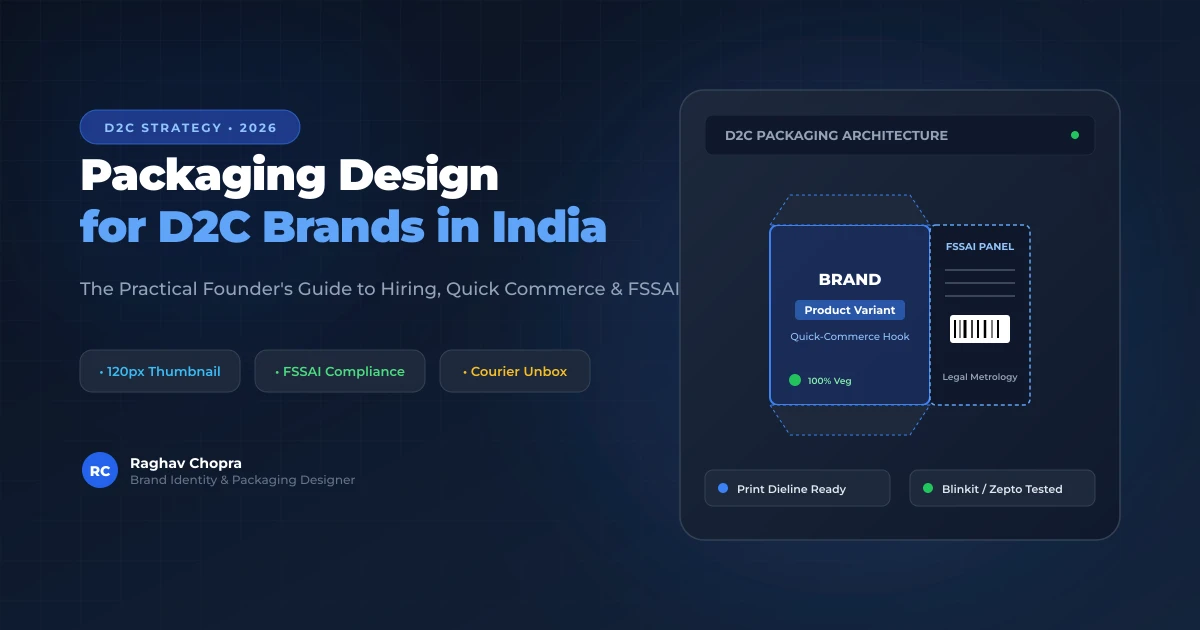
If you're building a D2C brand in India — selling through your own website, Amazon, or quick commerce apps like Blinkit and Zepto — your packaging has to do a job that traditional retail packaging never had to do: convince someone in under two seconds on a phone screen, survive a courier journey, and still look premium when it's unboxed at home. A packaging designer who has only worked on retail shelf design will optimise for the wrong thing. Shelf packaging competes against 40 other boxes under store lighting. D2C packaging competes against a thumb scrolling past it in a 3-inch product thumbnail, then has to survive a Delhivery or Shadowfax parcel before anyone sees it in person. This is the gap most Indian packaging agencies miss, because most of their client base is still traditional FMCG.
Hiring a D2C packaging designer in India requires verifying three core capabilities: production-ready dielines with bleed/fold engineering, statutory FSSAI compliance built directly into the grid, and thumbnail legibility tested for quick-commerce apps.
- Test pack hierarchy at 120px app thumbnail scale for Blinkit and Zepto.
- Demand flat vector dielines (.AI/.EPS) with crease, cut, and glue flap specifications.
- FSSAI Regulation 5(4) requires mandatory compliance layout before visual styling.
- Courier logistics (Shadowfax, Delhivery) require high-barrier unboxing protection.
- Full commercial copyright ownership and vector master files must be agreed upfront.
Why D2C Packaging Is a Different Problem Than Retail Packaging
Traditional FMCG packaging was designed for a 10-foot supermarket aisle under bright fluorescent lighting. Shoppers had time to browse shelves, hold boxes, and turn them over. But for modern Indian direct-to-consumer (D2C) brands, the entire commercial journey begins on a 6-inch mobile screen.
Whether a consumer is scrolling Instagram ads, searching Amazon, or ordering on quick-commerce platforms like Blinkit and Zepto, your pack has approximately 1.5 seconds to register value before their thumb swipes away. Detail that looks elegant at 100% zoom in Figma disappears into a blurry smear at a 120px app thumbnail.
Furthermore, traditional retail goods ship on wooden pallets wrapped in shrink film directly to air-conditioned stores. D2C goods travel individually through third-party logistics (3PL) networks—Delhivery, Shadowfax, Shiprocket—undergoing extreme vibration, temperature fluctuations, and rough sorting. Packaging must be engineered mechanically to survive transit while retaining its pristine unboxing appeal.
What to Check Before Hiring a D2C Packaging Designer
1. Ask to see dielines, not just 3D renders: Almost every freelancer and agency will show you glossy 3D mockups. Fewer can show you the actual dieline—the flat, production-ready technical drawing with precise fold lines, bleeds, barcode quiet zones, and glue flaps that a commercial printer uses. A designer who cannot deliver print-ready vector dielines hands you artwork a converter must redraw, delaying launches by weeks.
2. Confirm FSSAI compliance is built in, not bolted on: Under the FSSAI Labelling and Display Regulations (2020), every food, beverage, and wellness product must display statutory panels—mandatory nutritional information, veg/non-veg logos, allergen warnings, license numbers, and batch coding. Designers unfamiliar with compliance often design the front aesthetics first and squeeze mandatory text into an unreadable back corner. Compliance must inform the grid layout from day one.
3. Verify quick-commerce thumbnail legibility: When selling on Blinkit, Zepto, or Swiggy Instamart, your packaging thumbnail is your primary storefront. High contrast, clear flavor cues, bold variant typography, and minimal visual noise ensure high tap-through conversion rates.
4. Establish revisions and source file ownership upfront: Confirm in writing that your project includes complete vector source files (.AI, .EPS, .PDF) with converted outlines and full commercial usage rights. Clarify structured revision rounds before kickoff to keep your timeline on track.
5. Insist on category-specific packaging expertise: Pouch packaging for spices requires specialized aroma-barrier laminates; glass beverage bottles require moisture-proof label adhesives; skincare requires tamper-evident seals and dropper carton dielines. Look for demonstrated proof in your specific category.
Common D2C Packaging Mistakes That Quietly Cost Sales
Over-designing for print, under-designing for thumbnail: Delicate fine-line illustrations and intricate serif fonts look gorgeous on desktop monitors but become completely illegible on smartphone screens. Always test packaging designs at 120px scale on actual mobile devices before printing.
Treating compliance declarations as an afterthought: Cramped nutritional tables, missing allergen disclosures, or wrong symbol dimensions can trigger statutory notices, customs holds, or marketplace de-listing. Regulatory precision reflects brand credibility.
Ignoring the unboxing moment: The moment a customer tears open a delivery mailer is your most intimate brand touchpoint. Investing in branded tissue, internal box printing, or thank-you cards transforms ordinary deliveries into social share moments.
Skipping physical prepress mockups and drawdowns: RGB screen colors never match CMYK or Pantone spot printing exactly. Skipping a hardcopy digital proof or unprinted white-dummy dieline sample frequently leads to costly box sizing mismatches and reprints.
What a Complete D2C Packaging Engagement Should Include
A professional, end-to-end D2C packaging design engagement should encompass: (1) Discovery covering target audience, pricing, and distribution channels (site, quick commerce, Amazon); (2) 2-3 distinct visual concept directions with strategic rationale; (3) Refined final artwork with photorealistic 3D renders for marketing; (4) Production-ready dielines with exact cut, crease, and bleed margins; (5) Full FSSAI compliance declarations integrated into the grid; (6) 100% editable vector source files with brand packaging guidelines; (7) Realistic delivery timelines (typically 7-14 business days).
Related Services
Key Takeaway
Your packaging is your brand's hardest-working physical asset—it sells the product online, protects it in transit, and confirms its quality the moment it is opened. Investing in a designer who combines creative shelf impact with strict technical prepress and statutory compliance ensures your brand scales profitably without costly rework.

Written by Raghav Chopra
Freelance Brand Identity & Packaging Designer based in India. Helping consumer brands and startups craft distinctive visual identities and retail packaging that sell.