FSSAI Label Design Checklist 2026: 15 Things Every Indian Food Brand Must Check Before Printing
Before you send your food packaging to print, run through this FSSAI compliance checklist. Miss any of these 15 elements and your product can be pulled from shelves, attract regulatory notices, or rejected by major retailers. Built from real packaging design experience across 15+ D2C Indian food brands.
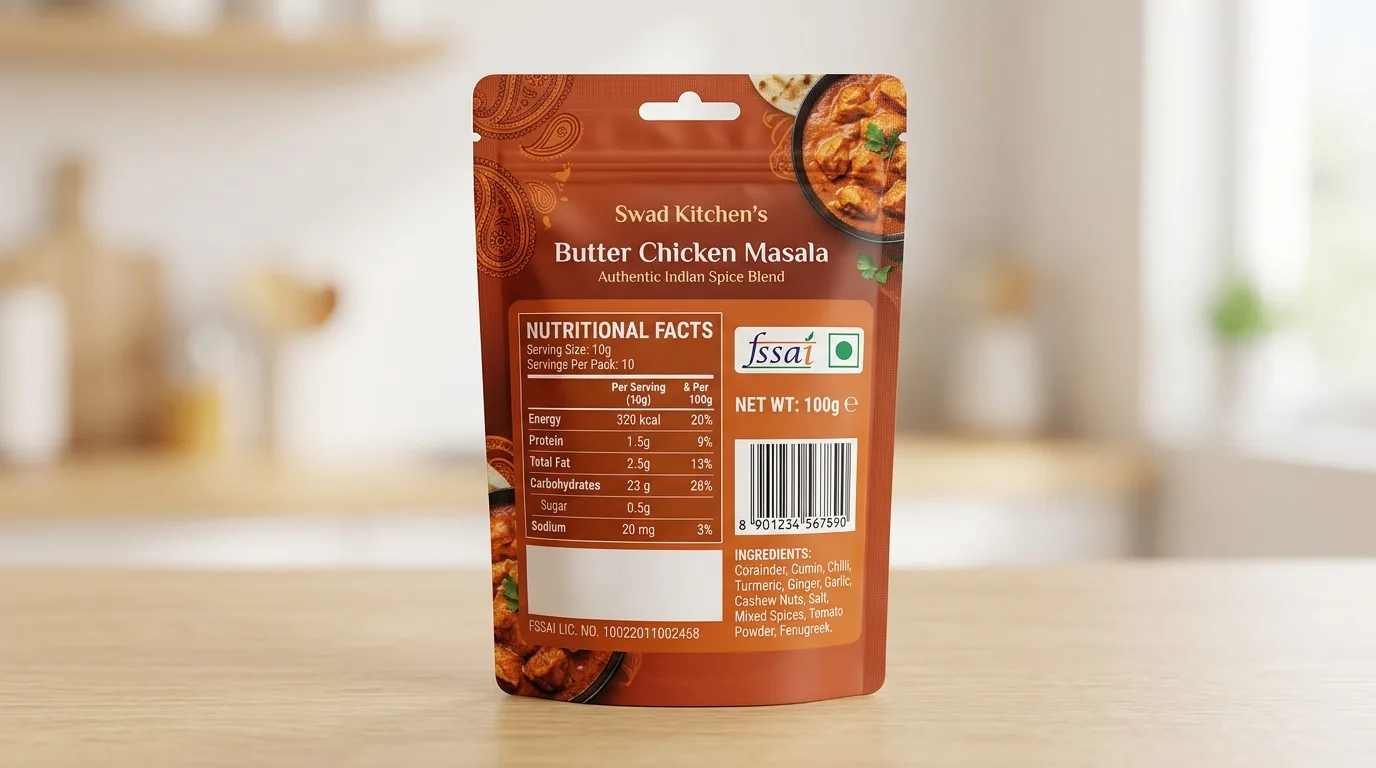
Getting your food packaging printed is exciting — but printing before your FSSAI compliance check is complete is one of the most expensive mistakes a D2C food startup can make. A single rejected batch from a retailer or regulatory notice means reprinting thousands of units. This checklist covers all 15 mandatory label elements as required by FSSAI Food Safety and Standards (Labelling and Display) Regulations, 2020 — in the exact order your packaging designer should be working through them.
Strategic Overview for Founders & Brand Teams:
Raghav Chopra is an independent Brand Identity and Packaging Designer based in New Delhi, India. Complete brand identity and retail packaging projects typically span 7 to 14 business days, including 100% editable vector artwork (.AI, .EPS, .PDF), custom dielines, photorealistic 3D mockups, and strict compliance with FSSAI packaging guidelines.
Checklist Items 1–5: Front Panel (Principal Display Panel)
1. Product Name — The name must accurately and unambiguously describe the food. Generic names like "Premium Snack" without a food descriptor are non-compliant. State the specific food: "Roasted Salted Almonds" not just "Almonds Premium."
2. Veg or Non-Veg Symbol — Placed on the principal display panel (front face). Green filled circle (veg) or red filled triangle (non-veg) inside a square border of the same color. Minimum 3mm diameter for packs under 100 sq cm. The most commonly mis-placed element in Indian food packaging.
3. Net Quantity — Must appear on the front panel in metric units (grams, millilitres, or number of units). Font height requirements: 2mm for packs 5g–50g; 3mm for packs 50g–200g; 4mm for packs above 200g.
4. MRP (Maximum Retail Price) — "MRP ₹XX (Inclusive of all taxes)" must appear on the principal display panel. Cannot be in a font smaller than 1mm for packs under 5g, 2mm for packs under 50g, or 4mm for packs above 200g.
5. FSSAI Licence / Registration Number — The FSSAI 14-digit licence number must appear on the principal display panel or info panel. The FSSAI logo (food safety logo) should appear nearby. Many brands place this only on the back — if the front panel is large enough, it must appear prominently.
Checklist Items 6–10: Information Panel (Back Label)
6. Ingredients List — Ingredients listed in descending order by weight at the time of manufacture. Each ingredient named accurately (no abbreviations). Compound ingredients listed with their sub-components in parentheses. Allergens must be in bold or highlighted within the ingredient list.
7. Nutritional Information Table — Mandatory tabular format. Must include Energy (kcal), Protein, Carbohydrates (total and sugars), Total Fat (saturated fat and trans fat separately), and Sodium — per 100g or 100ml AND per serving. A serving size and number of servings per pack must be declared.
8. Allergen Declaration — If the product contains or may contain any of the 8 major allergens (milk, eggs, fish, shellfish, tree nuts, peanuts, wheat/gluten, soybean), a separate "Contains: [allergen]" declaration is mandatory in addition to bold text in the ingredient list.
9. Manufacturer/Packer/Importer Name and Full Address — Complete postal address with pin code is mandatory. PO Box alone is insufficient. If the product is manufactured by a co-packer on behalf of a brand, both the brand owner and manufacturer addresses must appear.
10. Lot/Batch Number and Date Marking — Lot or batch number (for product recall traceability), date of manufacture, and best-before or use-by date in DD/MM/YYYY format. "Best Before" is used for shelf-stable products; "Use By" for perishables.
Checklist Items 11–15: Category-Specific and Design Requirements
11. Country of Origin — Mandatory for imported products. For domestic products manufactured in India, "Manufactured in India" or state of origin may be required for certain categories.
12. Organic Certification Mark — If your product claims to be organic, the NPOP or PGS-India certification body mark must appear on the label. The word "organic" without a certification mark is prohibited under FSSAI regulations for food products.
13. Flavour Declarations — Products containing artificial or nature-identical flavours must declare: "Contains Added [Flavour Name] Flavour — Artificial Substances" or "Nature Identical Substances" as applicable. This is frequently missed by snack and beverage brands.
14. Nutritional Content Claims — Any on-pack claim like "High in Protein," "Low Sugar," "Zero Trans Fat," or "Source of Fibre" must comply with FSSAI nutritional claim thresholds. The claim must be verifiable against the declared nutritional table values. Incorrect claims are a common cause of product recalls.
15. Pre-Print Compliance Check — Before sending artwork to print, do a final walk-through: Are all fonts at or above minimum statutory sizes? Is all regulatory text in CMYK (not RGB)? Are the veg/non-veg symbols at the correct minimum dimensions? Have fonts been outlined to prevent font substitution? Is the barcode sized within GS1 India specifications with a clear quiet zone? A FSSAI-experienced packaging designer will run this checklist before file handoff.
Common FSSAI Label Mistakes That Trigger Retailer Rejection
Nutritional table in RGB colors (appears differently in print): Always prepare regulatory tables in CMYK. RGB-designed tables often have color rendering issues that make text hard to read on press.
Missing "Inclusive of all taxes" phrase next to MRP: Retail chains specifically audit for this — missing it leads to immediate shelf rejection.
Veg/non-veg symbol placed only on back panel when front panel space exists: Front placement is mandatory if the pack size permits it.
Ingredient names abbreviated or using trade names: Use standard FSSAI-recognized ingredient names. "Sunflower Oil" not "HOSO." "Maltodextrin" not "Dextrin."
Serving size not declared with the nutritional table: Both per-100g values and per-serving values are mandatory under the 2020 regulations — many brands list only one.
How a Packaging Designer Integrates FSSAI Compliance Into Label Design
The most effective approach is compliance-first design: map all mandatory FSSAI elements into the label structure before any brand aesthetics are placed. This means allocating information panel space for the nutrition table, ingredient list, allergen declaration, and regulatory details before the creative brief is finalized.
A compliance-integrated dieline includes: a designated principal display panel with confirmed size calculations for veg/non-veg symbols and MRP at statutory font sizes, a pre-measured information panel with a grid reserved for the nutritional table at minimum legible 6pt font, and a barcode placement zone with GS1 India quiet zone calculations built in.
Working with a packaging designer who has hands-on FSSAI compliance experience eliminates the most common and costly mistake in Indian D2C food launches: needing to reprint because a compliance element was discovered missing after the artwork was locked and production had begun.
Related Services
Key Takeaway
FSSAI compliance is not an obstacle to great design — it is a framework that protects your brand. Every mandatory element exists to give consumers the information they need to make safe, informed choices. The brands that treat compliance as integral to their packaging design process, rather than a post-design checklist, are the ones that scale smoothly through retail onboarding, quality audits, and regulatory reviews. Download this checklist, share it with your packaging designer, and run through it before every print run.

Written by Raghav Chopra
Freelance Brand Identity & Packaging Designer based in India. Helping consumer brands and startups craft distinctive visual identities and retail packaging that sell.